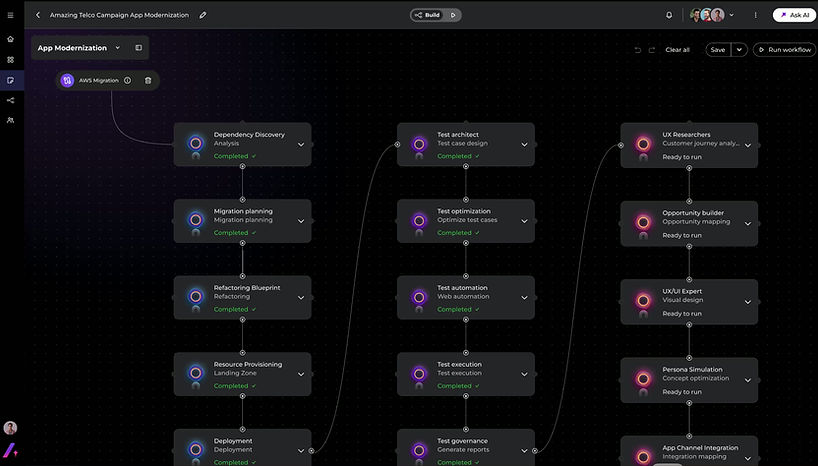
Agentic Services
AI Web platform | 2026


MY CONTRIBUTION
I worked as a Product Designer (UX/UI) within a broader design team, focusing on improving and extending the existing Agentic Services experience. My contribution included product experience design, workflow design, UX/UI flows, prototypes, visual exploration, and demo materials, in collaboration with product managers, designers, and developers. The work also supported internal reviews, leadership presentations, sales enablement, and potential customer demos.
SCOPE
Product Experience Design, Workflow Design, Detailed Design, Concept Design
SKILS
Product Thinking, Concept Development, UX/UI, Cross-team Collaboration
BACKGROUND
In large enterprises, what looks like a single project often becomes a chain reaction. Replacing a customer-service system, for example, can involve business goals, support pain points, technical dependencies, risk reviews, testing, and approvals.
As work moves between teams, context has to move with it: documents, decisions, outputs, and next steps. When that chain breaks, teams lose clarity, repeat work, and slow down.
This product was built around this reality: a shared workspace where specialized AI agents help teams run complex work as guided workflows, generate artifacts, carry context forward, and keep people involved where review or approval is needed.
This case study focuses on shaping that experience: how teams start, run, review, and continue agentic workflows across structured and exploratory work.


THE PROBLEM
Large enterprises are made of different teams with different goals, workflows, and levels of technical expertise. Some teams work with predefined processes, clear inputs, and structured execution, while others begin with partial context and move through exploration, review, and refinement.
The product challenge was to create one shared agentic platform that could support those different ways of working without becoming too rigid for exploratory teams or too loose for structured enterprise execution. The experience had to stay flexible, but still provide the visibility, control, and governance expected from an enterprise system.
RESEARCH
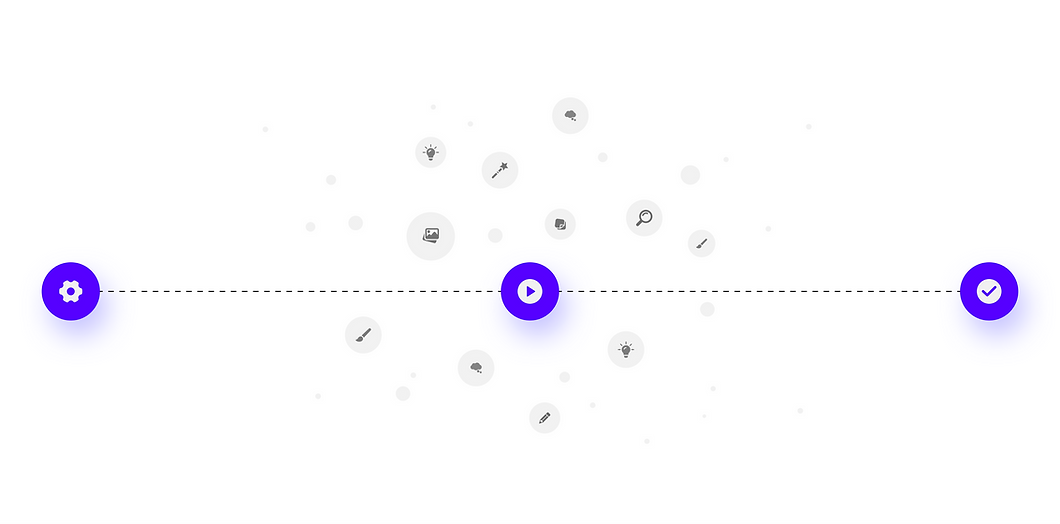
To shape the experience, we first needed to understand how work actually happens across the platform:
how projects are structured, how different teams operate, what inputs and outputs each phase depends on, and where automation could support the process without removing the human from it.
To do that, we combined several lightweight research and discovery methods that together, helped us define the platform’s information architecture, identify different working models across studios, and uncover the interaction gaps that the new experience needed to solve
UX APPROACH
Defining the experience model
The research surfaced a broader challenge than usability alone: the product had to support different ways of working, different levels of control, and different relationships between people, workflows, and outputs.
We translated those findings into three principles that guided both the interaction model
and the detailed design.

Keep structure,
but don’t force it upfront
Support predefined workflows without forcing every user to start there. For more exploratory work, the interaction had to begin from intent and evolve through guidance and refinement.

Make output part of the interaction, not just the result
Keep artifacts visible and usable throughout the process, so users can review, adjust, and continue from what is being created.

Keep human judgment inside
the system
Preserve meaningful review points where users can validate outputs, adjust priorities, and decide what should move forward.
THE SOLUTION
Designing a more natural way to work with agentic systems
The solution brought these principles together into a working model built around two complementary modes: structured workflow orchestration and a more direct conversational layer.
A shared working surface connected chat, project context, live artifacts, and workflow progress, allowing users to move between execution, review, and refinement in one place.
Alongside the UX changes, the interface evolved into a more dynamic and immersive environment that better reflected the product’s AI-native behavior.
Experience model
A system designed for both structure and exploration.
Rather than forcing every task into the same flow pattern, the product was designed around two complementary modes of work:
Build and Run.
PROJECT WORKSPACE
Persistent context, outputs, and next actions
BUILD MODE
Structured workflow orchestration
-
Define workflow
-
Agents + phases
-
Structured overview
-
Monitor progress
RUN MODE
Conversational execution layer
-
Start from intent
-
Chat with the system
-
System suggests workflow
-
Refine outputs
SHARED ARTIFACTS
Generated outputs for review and refinement
.png)
Build and Run
Users could move between structured workflow orchestration and conversational execution without losing context, selected agents, or provided inputs.

Autonomy adapted to the workflow
The system supported fully autonomous, semi-supervised, and manual execution, allowing different levels of human control depending on the task.


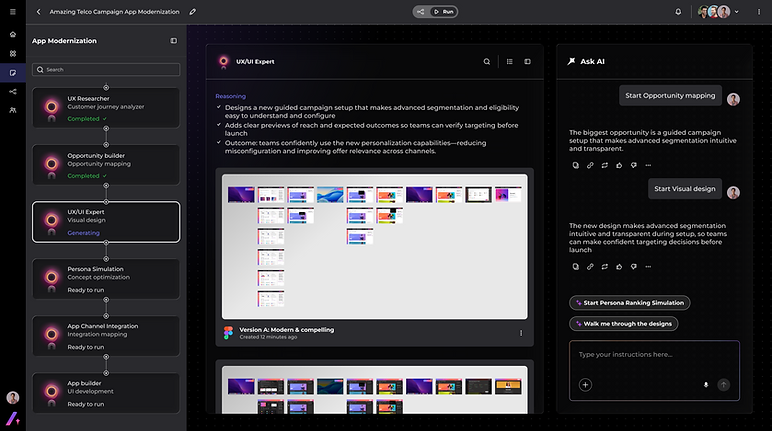
Chat and artifacts became one working surface
The assistant did more than answer questions.
It collected inputs, exposed reasoning, and suggested next actions while users reviewed, edited, and acted on live outputs inside the same space.
Projects became persistent workspaces
Each project kept context, workflow progress, generated outputs, and recommended next actions connected over time, so users could return to the work without rebuilding the project state from memory.


Workflow execution in practice
A selected workflow execution showing how an app modernization project moves across specialized agents, from journey analysis and opportunity mapping to design concepts, validation, integration planning, and app generation — with reasoning, artifacts, and next actions kept in one project context.