Agentic Services
AI Web platform | 2026


MY CONTRIBUTION
I worked as a Product Designer on Agentic Services, contributing to the end-to-end design of an evolving enterprise AI product. My work included shaping core workflows and interaction models, designing UX/UI flows and prototypes, and translating complex business and technical requirements into clear product experiences, in close collaboration with product managers, designers, and developers.
SCOPE
Product Experience Design, Workflow Design, Detailed Design, Concept Design
SKILS
Product Thinking, Concept Development, UX/UI, Cross-team Collaboration
BACKGROUND
Agentic platforms represent a new generation of AI that can independently plan, adapt, and execute complex tasks with minimal human intervention. Designed to operate more like digital employees, they are especially suited to enterprise workflows that span systems, roles, and data sources.
Agentic Services is a B2B enterprise AI product for the telecom domain, created as a strategic response to this market shift and the opportunity to lead the transition toward agentic ways of working.
This case study explores how that vision was translated into a clear, usable, and flexible product experience for different types of users.


THE CHALLENGE
Large-scale, cross-functional projects evolve across interconnected workstreams, teams, tools, and delivery phases, for example, from pre-sales and discovery through product definition, design, engineering, and quality assurance.
Knowledge, decisions, dependencies, and artifacts are distributed both within teams and across them, requiring continuous alignment and persistent context throughout the end-to-end project lifecycle.
As market expectations shift toward faster, more automated delivery with less manual effort, this operating model constrains speed, consistency, and scale. The challenge was to create one AI-driven workspace that could preserve project context end to end, support different working models across disciplines, and provide clear visibility into progress, ownership, and outcomes.
RESEARCH
To explore this tension, the discovery phase examined the challenge from two complementary perspectives: the strategic ambition behind the initiative and the emerging agentic product landscape.
We clarified the business goals, expected value, measures of success, and strategic constraints, while examining how comparable products approached agents, workflows, transparency, control, and human involvement.
Together, these perspectives helped us frame the opportunity and turn the initial assumption into a concrete product hypothesis that could later be tested with users.
INITIAL PRODUCT HYPOTHESIS
Organizing work around agents
Together, the stakeholder conversations and market research gave us a clear first direction to test.
The business vision placed specialized agents and their coordination at the center of the product’s value, while the market showed that exposing this orchestration through a canvas was a common way to create visibility and control.
We translated this direction into an initial agent-centered flow builder, where users could create an AI-agent workflow around the work they or their team needed to complete.
Each specialized agent applied its own skills and produced relevant artifacts that informed the next step, allowing the workflow to carry knowledge and context forward and provide the team with the outputs needed throughout the project.


The concept gave users direct control over how complex, multi-stage work was structured and made the agentic process visible throughout the experience.
But we still did not know whether this model matched how different users actually began, managed, and developed complex work.
Three key questions remained:
1
Do users think about their work through agents and workflows, or do they begin with the task they want to complete?
2
Can and do they want to define the structure of the work upfront?
3
And can a plan-and-run model support work that evolves iteratively throughout the process?
USABILITY
The limits of a workflow-first model
User testing across different teams and disciplines revealed that while the agent-centered flow builder had clear value for more technical, structured work processes, it lacked support for more exploratory and iterative ways of working, where the process evolves throughout the work.
This feedback pushed us to rethink the canvas as the product’s only working model.

I don’t always know the full process before I start. I need to explore, evaluate, and refine the work as I go.

I usually start with a specific task. I don’t want to define an entire workflow before I can begin working on it.

Our work is highly visual. We need to see it evolve in real time and understand how each change affects the overall direction.
UX APPROACH
Defining the experience model
Based on user feedback, we realized the product needed to support different ways of working, not just a single workflow-first model. This led us to define a more flexible experience approach, balancing structure, continuous iteration, and human control.
We centered the experience around:

Keep structure,
but don’t force it upfront
Support predefined workflows without forcing every user to start there. For more exploratory work, the interaction had to begin from intent and evolve through guidance and refinement.

Make output part of the interaction, not just the result
Keep artifacts visible and usable throughout the process, so users can review, adjust, and continue from what is being created.

Keep human judgment in
the loop
Preserve meaningful review points where users can validate outputs, adjust priorities, and decide what should move forward.
THE SOLUTION
Designing a more natural way to work with agentic systems
The solution brought these principles together into a working model built around two complementary modes: structured workflow orchestration and a more direct conversational layer.
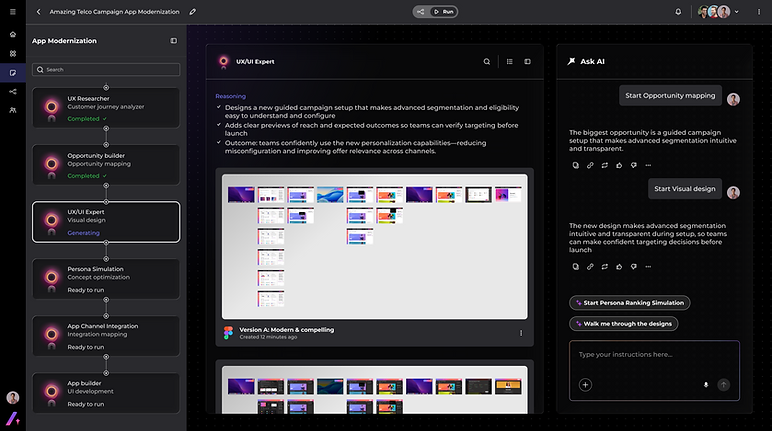
A shared working surface connected chat, project context, live artifacts, and workflow progress, allowing users to move between execution, review, and refinement in one place.
Alongside the UX changes, the interface evolved into a more dynamic and immersive environment that better reflected the product’s AI-native behavior.
PROJECT WORKSPACE
Persistent context, outputs, and next actions
BUILD MODE
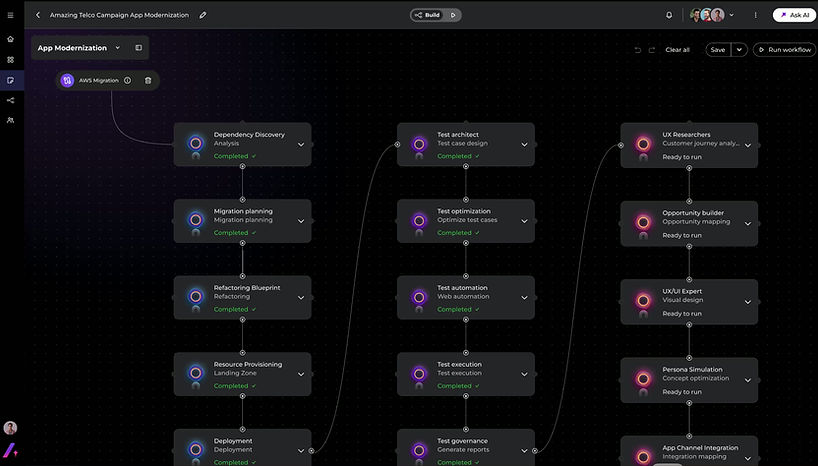
Structured workflow orchestration
-
Define workflow
-
Agents + phases
-
Structured overview
-
Monitor progress
RUN MODE
Conversational execution layer
-
Start from intent
-
Chat with the system
-
System suggests workflow
-
Refine outputs
SHARED ARTIFACTS
Generated outputs for review and refinement
.png)
Build and Run
Users could move between structured workflow orchestration and conversational execution without losing context, selected agents, or provided inputs.

Autonomy adapted to the workflow
The system supported fully autonomous, semi-supervised, and manual execution, allowing different levels of human control depending on the task.


Chat and artifacts became one working surface
The assistant did more than answer questions.
It collected inputs, exposed reasoning, and suggested next actions while users reviewed, edited, and acted on live outputs inside the same space.
Projects became persistent workspaces
Each project kept context, workflow progress, generated outputs, and recommended next actions connected over time, so users could return to the work without rebuilding the project state from memory.


Workflow execution in practice
A selected workflow execution showing how an app modernization project moves across specialized agents, from journey analysis and opportunity mapping to design concepts, validation, integration planning, and app generation — with reasoning, artifacts, and next actions kept in one project context.
Outcome
As Agentic Services progressed through validation and productization, selected use cases showed meaningful operational impact, from shorter delivery timelines and higher productivity to less manual effort across complex, multi-stage work.
67%
Shorter delivery timelines
25%
Productivity gain
34 hours
Manual execution time saved per project